
From Schematics to Startup: What You Should Know About Control Panel Fabrication
Most control panel projects start with a simple request. A new machine needs controls, or an aging panel is overdue for replacement. Then the real questions begin to surface. What will the panel control? Does it need an Underwriters Laboratories (UL) listing? Who programs it, tests it, and shows up on startup day?
How those questions get answered decides whether your new panel is installed and performs as expected, or spends its first few weeks being reworked. Here’s what’s worth knowing before you place the order:
- The engineering, components, and testing behind a well-built panel
- Why your equipment and workflow should shape the design
- How to tell early whether UL 508A applies to your project
- The capabilities that separate a controls partner from a box builder
- What a nearby controls team adds to projects in Oklahoma and Texas
- The questions that expose gaps in a quote before you commit
Planning a new or replacement industrial control panel? Request a project consultation with OSCO Controls.
A Control Panel Should Be Designed Around What It Controls
Here’s something that surprises many buyers. Two panels can share the same enclosure and the same PLC and still behave completely differently once they’re wired to real motors, sensors, and operators. The difference is whether the panel was designed around the equipment, the process, and the conditions it will operate in.
That’s why OSCO treats control panel fabrication as a process rather than a product. Engineering, component selection, assembly, programming, testing, and integration all build on each other. As an Oklahoma-based controls company, OSCO Controls supports industrial projects throughout Oklahoma, Texas, and beyond, and we’ve been building panels this way since 1992.
What Industrial Control Panel Fabrication Really Involves
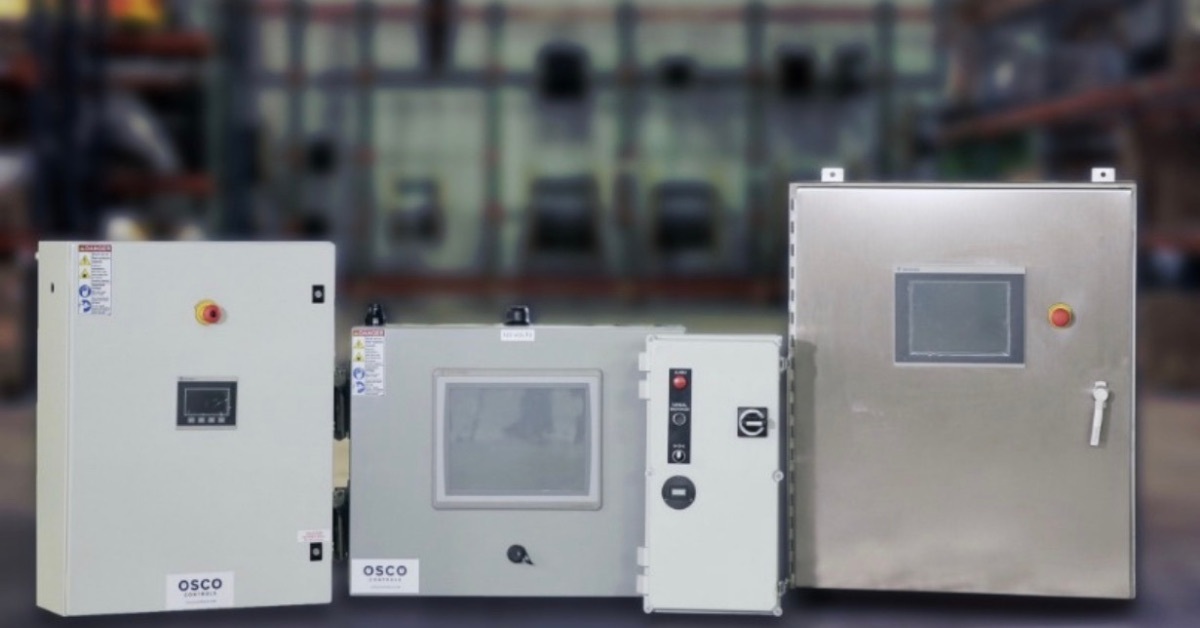
From the outside, a finished panel doesn’t look like much: a steel box, a door, and a few indicator lights. Inside, dozens of decisions determine whether your equipment runs reliably for years or trips offline at the worst possible moment. Industrial control panel fabrication covers far more than mounting components inside an electrical enclosure.
Electrical Design and Schematics
Every good panel starts as a drawing. Before anyone cuts a wire, our electrical schematics map out power distribution, control circuits, protective devices, and every input and output. Later, they become the map your maintenance team uses for troubleshooting, so they must match what’s actually inside.
Component Selection and Panel Layout
We choose components for the electrical load, the operating environment, and how easy they’ll be to replace years from now. Panel layout matters as much as the components themselves. Heat-producing devices need airflow, wiring needs separation, and technicians need room to work.
PLCs, HMIs, VFDs, Relays, Power Supplies, and Other Controls
Think of PLC control panels as the brains of the operation, HMIs as the window operators look through, and VFD controls as the hands on each motor’s speed and torque. Relays, power supplies, circuit protection, and safety devices complete the system.
Wiring and Labeling
We route and label every wire to match the drawings, and that pays for itself the first time something goes wrong. When a technician can trace a circuit from the schematic to the terminal in minutes, downtime is kept to a minimum.
Assembly and Documentation
Assembly follows the approved design, and documentation follows the assembly. Our documentation package typically includes as-built drawings, a bill of materials, and the program files. If you’ve ever inherited a panel with no drawings, you already know why this matters.
Testing Before Delivery or Implementation
The best place to find a wiring error is on a workbench in the shop, not on your production floor. That’s why every panel leaving our shop goes through point-to-point wiring checks, power-up tests, and I/O verification, catching problems while they’re still quick and inexpensive to fix.
One more thing worth knowing: OSCO builds panels for engineered control applications rather than operating as a component distributor or reseller. Every panel we fabricate carries a control solution our team has designed and tested for that application.
We Let the Application Drive the Panel Design
A panel designed around a parts catalog can look great on delivery day. A panel designed around your equipment and workflow still makes sense two years later. Before industrial control panel design begins, our engineers work through these questions with you.
Equipment and Process Requirements
What is the panel controlling, and what does that equipment need to accomplish? A packaging line, a mixing system, and a metal-forming press each call for different control logic, safety functions, and operator interaction. Once we understand the process, much of the panel design follows naturally.
I/O Requirements
Counting I/O points sounds simple until the list keeps growing. Every input, output, safety signal, and specialty device affects PLC hardware and panel size. We lock down the list early, so you don’t end up squeezing modules into a panel that was never laid out for them.
Motor and Drive Requirements
How big are the motors, and how do they need to start and run? Whether a motor starts at full speed, ramps up gradually, or runs on a VFD affects heat load, enclosure size, and wiring. Accurate motor information early in the project helps avoid costly redesign of the panel’s power section.
Existing Equipment and Controls
Very few panels go into an empty building. Most have to work with existing machines, legacy PLCs, or a plant standard already in place. Knowing what’s there, from platforms and protocols to the spare parts on your shelf, keeps a new panel from becoming an island.
Facility and Environmental Conditions
Heat, humidity, washdown, dust, and outdoor exposure all shape enclosure ratings and cooling. A panel for a climate-controlled electrical room is built very differently from one mounted outdoors at a compressor station in West Texas. If the panel will operate near flammable gases, vapors, or combustible dust, hazardous location requirements add another layer of design considerations.
Networking and Communication Requirements
Today’s panels rarely work alone. They share data with other PLCs, plant-wide production software, and remote monitoring tools. Deciding how the panel connects, and what your IT team requires, belongs in the design conversation. Retrofitting network hardware into a finished panel often means rearranging components and rerouting wiring.
Future Expansion
If there’s any chance the line will grow, let’s plan for it now. Spare I/O capacity, open mounting space, and extra room in the power distribution cost very little to include today. Adding them later can mean a second enclosure or a full rebuild.
Customer Specifications
Customer specifications can be wide-ranging. Some focus on operational needs, such as uptime targets, operator access, or how the system should respond to a fault. Others reflect regulatory or industry requirements, or the application’s specific demands. Many customers, equipment manufacturers (OEMs), and engineering firms also have their own standards for preferred brands, wire colors, labeling, documentation, and drawings. We build it all into the initial project scope, so nothing becomes a change order during final review.
Each of these factors benefits from having controls engineering involved before fabrication begins. When the same team defines the control strategy and guides the panel design, your requirements carry through accurately to the finished build, and the project stays on schedule.
Identifying UL 508A Requirements at the Start of a Project
UL 508A is a common requirement on panel projects. When it applies, it shapes component selection, layout, and documentation from the first drawing. Knowing early whether you need a UL listing keeps the design and schedule aligned.
What It Means to Work With a UL 508A Listed Panel Shop
UL 508A is the UL standard for industrial control panels. When you work with a UL 508A panel shop, your panel leaves the shop with the UL listing mark already applied, built by a team UL inspects on an ongoing basis. That mark shows inspectors and end customers the panel meets a recognized safety standard, which typically avoids a separate field evaluation before startup. OSCO is a UL 508A-listed shop certified for both the United States and Canada, and our listings also cover Class I, Division 1 and 2 and Class II, Division 2 hazardous-location panels.
When a Customer or Project Specification Requires UL 508A
The requirement usually comes from an end customer’s purchasing standard, an engineering firm’s project specification, an OEM shipping to sites that expect listed panels, or a local electrical inspector. A specification that calls for UL 508A often sets related requirements for enclosure ratings, labeling, component brands, and documentation. Share the full specification with your panel builder at the quote stage so they can create an accurate design and pricing.
Why UL Requirements Belong Early in the Design Process
A UL 508A listed panel is designed differently from an unlisted one. Component choices, spacing, short-circuit current rating (SCCR) calculations, and labeling must all meet the standard. Converting a finished panel can mean swapping components and reworking the layout. Mentioning a possible listing requirement during the quote avoids that rework.
UL 508A Certification When Requested or Required
Not every panel needs a UL listing, and not every panel OSCO builds automatically receives one. We provide UL 508A certification when you request it, or your project requires it. Every other panel gets the same build quality and testing, just without the formal listing and its documentation.
Evaluating a Control Panel Fabrication Partner Before You Place the Order
Our recent post on when to bring in a controls partner for an engineered industrial project covers how to recognize when a project needs outside controls expertise. Once you’ve made that call and are comparing panel quotes, confirm the following before placing the order.
Controls Engineering Capabilities
Start with a simple question: who is actually designing the control system? A control panel manufacturer with controls engineers on staff can walk through your process with you, raise the questions nobody has asked yet, and catch problems while they’re still lines on a drawing or items on a checklist.
Industrial Panel Design and Fabrication Experience
Motor control, process control, packaged equipment, and hazardous location panels each bring their own challenges. A shop that regularly builds a variety of panels has already worked through the learning curve.
UL 508A Capabilities
If your project needs a listed panel, confirm the shop holds a current UL 508A certification. Even if you don’t need one today, requirements can change between quote and delivery. Shipping equipment overseas? OSCO also builds panels to CE standards and works with third-party testers to register the CE Mark.
PLC and HMI Programming Expertise
When the panel comes from one vendor and the programming from another, it’s hard to tell who owns a problem. A partner that handles PLC and HMI programming is accountable for how the whole system behaves.
Documentation and Drawing Capabilities
Ask to see a sample drawing package. Complete electrical schematics, panel layouts, bills of material, and labels that match the drawings tell you a lot about how carefully the panel itself will be built.
Panel Testing and FAT Capabilities
Find out how panels are tested before they ship and whether factory acceptance testing (FAT) is available. FAT lets your team watch the panel run its logic before it reaches your floor. A shop’s approach to panel testing reflects its standards.
System Integration Experience
A panel that works on the bench still has to work with your equipment. Experience integrating with conveyors, process skids, robotics, drives, and plant networks shows up in how smoothly everything comes together in the field.
Ability to Work With Existing Equipment and Controls
Retrofits and expansions are part of life in most plants, and they’re rarely tidy. A capable partner can work with legacy PLCs, mixed-vintage equipment, and incomplete drawings, and give you a straight answer about what to keep and what to replace.
Startup and Implementation Support
Startup is where field wiring, device settings, and process tuning finally meet. A partner that can provide on-site startup support when your project requires it helps ensure a successful outcome.
OSCO Controls brings every one of these capabilities to each project. Our in-house team handles controls engineering, panel design and fabrication, UL 508A listing, programming, documentation, testing and FAT, integration, work on existing equipment, and on-site startup support if necessary. That gives you one partner accountable from the first conversation through commissioning.
Why Regional Controls Support Matters for Oklahoma and Texas Manufacturers
Geography may not be the first thing you compare on a quote, but it matters once the project is underway. As an Oklahoma-based panel builder, OSCO works with manufacturers across Oklahoma and Texas. For buyers sourcing industrial control panels Oklahoma and Texas operations can count on, that can mean a partner within driving distance. For plants farther out, it still means a team in the region rather than across the country. And for projects outside the region, we bring the same engineering and fabrication process nationwide.
Easier Collaboration With Engineering and Plant Teams
Some conversations just go better in person. Sitting at the same table and walking the line together makes design reviews more productive. A regional partner can join your kickoff meetings and invite your team to the shop to see the panel take shape.
Site Visits When Required
Some questions can’t be answered from drawings. Verifying existing wiring, confirming mounting locations, or watching how operators actually use a machine often means being there in person. Because we’re in the region, we can be on site when you need us.
Hands-On Startup and Implementation
Startup is the most time-sensitive phase of any controls project. Much of the troubleshooting and fine-tuning can be handled remotely. When your project calls for on-site startup support, our team is close enough to be there during commissioning and to return if something needs adjusting.
Familiarity With Regional Industrial Applications
Oklahoma and Texas share an industrial base that includes manufacturing, aerospace, distribution, midstream oil and gas, and industrial automation. Our engineers know the environmental conditions, industries, application types, and expectations common across the region, and they carry that familiarity into every design.
Continued Support for System Modifications and Upgrades
After startup, lines get reconfigured, and programs need updates. As a control panel manufacturer Texas and Oklahoma plants can reach easily, we’re in a good position to support those changes for years to come.
Questions That Clarify a Control Panel Quote Before You Commit
Two quotes for the same panel can land at nearly the same price and deliver a very different solution. A few straightforward questions can clarify those differences before you sign the purchase order.
Who Will Handle the Electrical and Controls Design?
Some shops build only from customer-supplied drawings. That works well when your design is already complete, but it leaves the design decisions with your team rather than with the people building the panel. When OSCO handles the design, our engineers own those decisions from ideation through startup.
Can You Provide PLC and HMI Programming?
HMI programming and PLC logic determine how the system actually runs. If a third party does the programming, find out who is responsible when the panel and the code don’t match.
Can the Panel Be UL 508A Certified If Required?
A yes should come with confirmation of a current certification. If the answer is “we can get it inspected,” that’s a different process, with different cost and schedule implications.
How Will the Panel Be Tested Before Delivery?
Listen for specifics such as point-to-point checks, power-up testing, I/O verification, and simulated logic testing. The more thorough the answer, the more likely the team is to catch issues in the shop instead of at your site.
What Drawings and Documentation Are Included?
Confirm that as-built drawings, a bill of materials, and program files are part of the deliverable, and in what format. That way, documentation doesn’t become an open item at project closeout.
Can You Integrate the Panel With Existing Equipment or Systems?
Ask for examples of similar integrations. Connecting to existing PLCs, drives, and plant networks is where many panel projects slow down, so real experience here pays off.
Do You Provide Startup or Implementation Support?
Find out whether support is included, offered as an option, or not available at all. Settling this before you place the order avoids a gap at the most critical point of the project.
Can the System Accommodate Future Modifications or Expansion?
Ask how much spare capacity is designed in, and whether the program is organized so another engineer can follow it. Building in capacity for growth now makes future changes much easier to accommodate.
Put Our Engineering Behind Your Next Control Panel
A great panel starts well before fabrication, with a clear picture of the equipment, the process, and the conditions it will operate in. That’s how we approach custom control panel fabrication at OSCO: our engineers are involved at every step, from programming and testing to startup.
For more than three decades, we’ve helped manufacturers turn control requirements into reliable, high-performing panels. Planning a new line, replacing an aging panel, or adding controls to packaged equipment? Our engineers can help you sort out the requirements before anything is built.
Talk with an OSCO controls engineer about your panel requirements.
Planning Your Next Industrial Control Panel Project With OSCO Controls
Successful control panel fabrication starts with understanding the application, not with selecting components. Once you clarify the process, equipment, environment, and long-term plans, every decision that follows gets easier. OSCO Controls supports projects from controls engineering and fabrication through programming, testing, and integration, giving manufacturers in Oklahoma, Texas, and nationwide one team accountable for project delivery and system performance.
Contact OSCO Controls to discuss the requirements for your next industrial control panel project.