
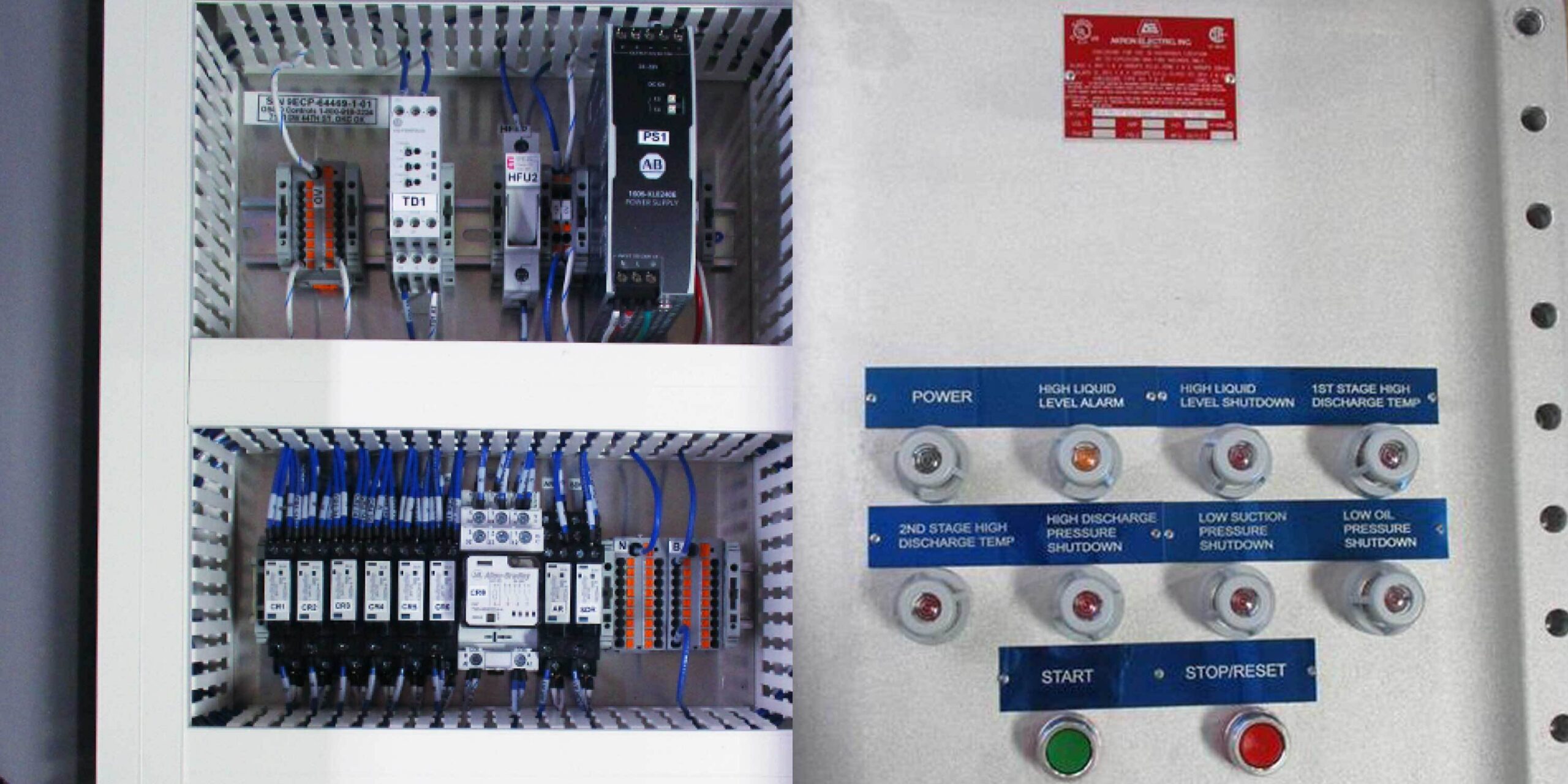
Designing UL-Certified Control Panels for Hazardous Locations with Confidence
If you’re specifying control panels for hazardous locations, you already know the stakes. In classified environments where flammable gases, combustible vapors, or explosive dust are part of daily operations, the wrong enclosure, the wrong protection method, or a misread classification can do more than fail an inspection — it can put people at risk and bring a project to a grinding halt. We’ve seen it happen, and it’s almost always preventable.
UL-certified control panels for hazardous environments must be built to UL 508A and NNNY standards. These standards define how panels must be designed, built, and certified — particularly when they’re installed in classified locations. But knowing which requirements apply, and how to interpret them correctly for your specific environment, takes more than a quick spec review. Misapplied classification, incorrect protection methods, and non-compliant pressurization systems have a way of surfacing at the worst possible moment.
This practical guide covers what engineering and operations teams need to understand before specifying or procuring control panels for hazardous locations:
- Why hazardous location compliance is foundational to safe industrial operation — and what’s at stake when requirements are misunderstood
- The most common compliance pitfalls that lead to inspection failures, redesigns, and project disruption
- How to match the right protection method — explosion-proof, nonincendive (designed to prevent ignition under normal operating conditions), or purged and pressurized — to your classified environment
- How to accurately interpret Class, Division, and Group classifications so your panel selection holds up under scrutiny
- Why pressurization requirements are more complex than most teams anticipate — and how to avoid noncompliant purge systems
- How partnering with an experienced UL-listed panel shop ensures your control panels for hazardous locations remain flexible, maintainable, and compliant over the life of the installation
Engage the OSCO Controls team early to clarify hazardous location requirements before design decisions introduce risk.
Why Getting Hazardous Location Compliance Right Matters from Day One
In facilities that handle flammable gases, vapors, or combustible dust, hazardous location compliance isn’t a formality — it’s the engineering foundation that makes safe operation possible. Control panels for hazardous locations must be designed to eliminate ignition sources under the specific conditions of the classified area. A panel that works perfectly in a standard industrial setting can become a liability the moment it’s placed in a classified environment without the right protection method — the engineering approach used to prevent ignition in a classified area — enclosure rating, and component approvals.
In North America, UL standards such as UL 508A and NNNY define how industrial control panels must be designed, built, and certified — particularly when used in hazardous or classified locations. Environmental classification is defined by the NEC. Together, these frameworks establish strict requirements across the board: enclosure integrity, approved components for the applicable Class and Division, compliant wiring methods, and thorough documentation. These aren’t independent items on a checklist — a gap in any one of them can compromise the others.
When hazardous location requirements are addressed early in the design process, inspection approval tends to go smoothly. When they’re deferred — or misunderstood — correction is almost always more expensive than early planning.
The Compliance Mistakes That Derail Hazardous Location Projects
One of the most common — and costly — assumptions we encounter is that a standard industrial control panel can be adapted for a classified area with a few modifications. It can’t. Control panels for hazardous locations require fundamentally different construction from the ground up. The enclosure, protection method, components, and conduit systems all have to be evaluated and specified together against the specific requirements of the classified environment.
A big part of what drives these mistakes is how often UL terminology gets oversimplified or misapplied. Terms like “explosion-proof,” “nonincendive,” and “Division 2” get used loosely — and when the actual construction requirements behind those terms aren’t understood, the wrong panel can end up in the wrong environment. Division 2, for example, is designed for areas where hazardous materials are only present under abnormal conditions — not as a substitute for Division 1 construction, where those materials may be present during normal operation. Common patterns we see include confusing enclosure type ratings with protection methods, misapplying Division designations, and overlooking Gas or Dust Group compatibility or temperature code alignment.
These issues have a way of staying invisible until an Authority Having Jurisdiction (AHJ) shows up for inspection. By that point, the options are rarely good: enclosure replacement, conduit resealing, component swaps, or full redesign, usually with very little schedule left to work with. The five compliance areas below are where most hazardous location projects run into trouble.
Choosing the Right Protection Method for Your Classified Environment
The protection method has to match the risk level of the classified area — not the other way around. Explosion-proof control panels, Class I Division 1 control panels, Class I Division 2 control panels, and purged and pressurized control panels are each engineered for specific environmental conditions. They’re not interchangeable, and specifying a lower-rated method for a higher-risk environment creates real safety, inspection, and liability exposure.
Explosion-Proof Control Panels
Explosion-proof control panels are built to contain an internal ignition event and keep flames from propagating into the surrounding atmosphere. These enclosures are typically required in Class I Division 1 environments — locations where flammable gases or vapors may be present under normal operating conditions. The construction relies on precisely engineered flame paths, flanged or threaded joints built to tight tolerances, and heavy mechanical construction capable of withstanding an internal explosion without failure.
Field modifications are where explosion-proof enclosures most often result in compliance problems. Unapproved penetrations, improperly sealed conduit entries, or added components that fall outside the enclosure’s certification parameters can invalidate the listing and undermine the protection the enclosure was designed to provide. Any modification needs to be treated with the same engineering discipline as the original construction.
Class I Division 2 Control Panels and Nonincendive Construction
Class I Division 2 control panels are designed for environments where hazardous gases or vapors would only be present under abnormal conditions — a process failure or accidental release, not routine operation. Nonincendive construction limits arc energy and uses appropriately rated components to reduce ignition risk during normal operation, without requiring the heavy containment construction of a Division 1 enclosure.
The differences between Class I Division 1 control panels and Class I Division 2 control panels go well beyond the label. Wiring methods, conduit sealing requirements, enclosure ratings, and component approvals all differ significantly. Installing Division 2 panels in a Division 1 area isn’t a gray area — it’s noncompliant, and it creates both inspection-failure risk and genuine safety and liability exposure that documentation alone can’t address.
Purged and Pressurized Control Panels
Purged and pressurized control panels work differently from explosion-proof or nonincendive designs. Instead of containing an ignition event, they prevent hazardous atmosphere from entering the enclosure in the first place by maintaining positive internal pressure using clean air or inert gas. Before energization, the enclosure must be purged to remove any hazardous gases or dust that may have accumulated inside.
The appeal of purged and pressurized systems is the design flexibility they offer — once the purge cycle is complete and pressure is maintained, standard components can be used inside the enclosure. That’s a meaningful advantage over heavy cast aluminum explosion-proof enclosures, which are mechanically complex, harder to modify, and more restrictive when it comes to component selection. Where the application allows, we recommend purged systems for exactly that reason. But that flexibility comes with real operational demands. Purge timing, airflow rates, pressure sensing, alarm logic, and in some cases, automatic shutdown all have to be properly engineered, documented, and maintained. Cut corners on any of those, and the compliance picture changes quickly.
Class, Division, and Group — Why Accurate Classification Is Non-Negotiable
Accurate classification of the hazardous area is the starting point for every other compliance decision. Get the Class, Division, or Group wrong, and the enclosure selection, component approvals, and certification that follow can all be built on a faulty foundation — even if the panel itself is well constructed.
Class I vs. Class II Environments
Class I environments involve flammable gases or vapors — petroleum processing, chemical manufacturing, paint finishing, and similar operations. Class II environments involve combustible dust — grain handling, pharmaceutical manufacturing, and metalworking processes that generate combustible particulates. Dust environments behave differently from gas environments. They have different ignition characteristics and require enclosure construction specifically designed to prevent dust accumulation and surface overheating. Class I and Class II enclosures are not interchangeable, and treating them as if they are is a mistake that tends to be expensive to correct.
It’s also worth noting that within Class II environments, Division matters just as much as it does in Class I. OSCO Controls can UL list panels for Class II Division 2 applications — but only when a purged system is used. A purged panel introduces clean air into the interior to create positive pressure, which expels potentially explosive atmosphere and eliminates the need for heavy dust-rated enclosure construction. If you have a Class II Division 2 application, that’s a conversation worth having early.
Division 1 vs. Division 2 Risk Levels
Division 1 designates areas where hazardous materials are present under normal operating conditions — during routine production, maintenance, or standard equipment operation. Division 2 designates areas where hazardous materials would be present only under abnormal conditions, such as a process failure or an accidental release. These designations have direct implications for enclosure type, conduit sealing requirements, approved component specifications, and permitted wiring methods. Applying Division 2 specifications to a Division 1 area isn’t a conservative tradeoff — it’s a compliance failure.
Gas and Dust Group Considerations
Hazardous materials are categorized into Groups based on their ignition characteristics — minimum ignition energy and maximum experimental safe gap for gases and vapors. Groups A through D apply to Class I environments; Groups E, F, and G apply to Class II dust environments. Closely tied to Group selection are temperature codes (T-codes), which define the maximum surface temperature equipment can reach under load. Selecting components or enclosures without verifying both Group and T-code compatibility against the specific materials in the facility is a detail that gets skipped more often than it should — and one that can render an otherwise compliant panel unsuitable for its environment.
Pressurization Requirements Go Deeper Than Most Teams Expect
Purged and pressurized control panels come with compliance requirements that extend well beyond the enclosure itself. The pressurization system has to be properly classified, engineered, and monitored — and AHJ inspections of purge systems are thorough enough that documentation failures can cause rejection even when the physical construction looks right.
Understanding Type X, Y, and Z Pressurization
Purged and pressurized systems are classified by the degree of protection they provide. Type X reduces the classification inside the enclosure from Division 1 to non-hazardous, which allows standard non-rated components to be used inside the panel. Type Y reduces Division 1 to Division 2 inside the enclosure. Type Z reduces Division 2 to nonhazardous. Each type carries specific requirements for purge duration, minimum airflow rate, pressure maintenance, and control logic. Selecting the right type starts with understanding the enclosure’s external environment — not with what’s most convenient for the panel layout.
Monitoring, Alarms, and What Inspectors Actually Look For
Pressurization systems need pressure sensors, properly configured alarm logic, and in many applications, automatic de-energization on pressure loss. During AHJ inspection, purge documentation, system labeling, and alarm functionality all get a close look. We’ve seen systems with correct enclosure construction fail inspection because the monitoring documentation was incomplete, alarm thresholds were set incorrectly, or shutdown logic wasn’t functioning as designed. The monitoring system deserves the same engineering attention as the enclosure itself.
Building in Flexibility Now Saves Significant Rework Later
UL-certified control panels for hazardous locations are built and labeled within defined construction parameters. Once a panel is certified, modifications must remain within the constraints of the approved enclosure type and component approvals. That limits flexibility for future changes in ways that aren’t always obvious during initial specification — but become very obvious when a process change requires a panel expansion that the original layout can’t accommodate.
Panels that weren’t designed with future I/O expansion or component accessibility in mind often end up requiring enclosure replacement or complete redesign when operational needs evolve. Designing for maintainability and scalability from the start — appropriate terminal spacing, modular layout, and clear documentation of certification constraints — doesn’t add significant upfront cost, but it can prevent disruption down the road.
UL Certification Is an Ongoing Commitment, Not a One-Time Milestone
The certification on a UL-certified control panel reflects the conditions under which it was designed, built, and inspected. When those conditions change — new process materials, facility layout modifications, changes in environmental exposure, updated regulatory requirements — the panel’s compliance picture can change along with them. A panel that was fully compliant at commissioning may no longer meet NEC requirements if the operating environment has shifted.
Periodic review of installed hazardous location panels against current operating conditions is how compliance is maintained rather than assumed. Operating outside certified conditions increases inspection risk, extends liability exposure, and in some cases affects insurance coverage. Organizations that treat initial certification as the finish line tend to encounter compliance issues at moments when they’re least prepared to deal with them.
What to Do When You Recognize These Issues — and Why Early Engagement Changes Everything
If any of the compliance gaps described above sound familiar, the most important thing is to address them before they reach inspection. Engaging a UL-listed panel shop early — at the classification and design stage rather than after fabrication has begun — gives you the best possible opportunity to get it right without the cost and schedule pressure of late-stage correction.
Working with an experienced hazardous location controls partner early in the process means classification requirements get interpreted correctly from the start, protection methods are matched to the actual risk level of the environment, pressurization systems are designed with full monitoring and documentation built in, and panels are laid out with future flexibility in mind. These aren’t afterthoughts — they’re decisions that need to be made before the first component is specified.
How OSCO Controls Supports Hazardous Location Projects from Design Through Lifecycle
As a UL 508A-listed panel shop with approved hazardous location capabilities, OSCO Controls designs and manufactures compliant control panels for hazardous locations in accordance with NEC requirements. We can UL list panels for Class I Division 1 and Class I Division 2 environments, as well as Class II Division 2 applications where a purged system is used. With more than 30 years of industrial automation experience, we’ve worked through the full range of hazardous location challenges — explosion-proof and purged and pressurized systems across a wide range of industries and classified environments.
Our involvement doesn’t end at fabrication. From initial classification review and protection method selection through panel design, build, inspection support, and long-term lifecycle service, we work alongside clients to ensure compliance holds up — not just at commissioning, but throughout the life of the installation. For a full overview of our certifications and industry affiliations, read our OSCO Controls Certifications & Affiliations blog, or see the OSCO Controls Certifications page for a current list of our approved capabilities.
Start the Hazardous Location Conversation Before It Becomes a Problem
The decisions that most affect safety, inspection approval, and long-term operational reliability in hazardous location projects are made early — during classification review, protection method selection, and initial panel design. Those early decisions are also where it’s easiest and least expensive to get things right. Waiting until fabrication is underway — or until an AHJ inspection reveals a compliance gap — dramatically limits the options available.
Ready to ensure your hazardous location control panels are compliant from day one? Contact OSCO Controls to design UL-certified control panels aligned with your safety and regulatory requirements.
OSCO Controls Delivers UL-Certified Control Panels for Hazardous Locations Built to Last
Hazardous location environments don’t leave much room for interpretation errors or compliance shortcuts. Precise classification, disciplined construction, and accurate certification documentation all have to work together — and when one piece is off, the consequences tend to compound. OSCO Controls brings more than 30 years of industrial automation experience to every hazardous location project — designing and manufacturing custom control panels with control systems integration built in, ensuring your panels work seamlessly with the broader systems of your facility from day one. From initial classification review through fabrication, inspection support, and long-term lifecycle service, we’re with you at every stage. That’s the kind of partnership that turns a complex compliance challenge into a confident, well-executed project.
Let’s talk. Contact OSCO Controls to design and manufacture compliant hazardous location control panels built for safety, reliability, and long-term performance.